Stepping into Biocultural Restoration:
The Hawaiian Hardwoods Community Forest
By Samantha Alvarado, March 7, 2026
As our ecological restoration efforts continue to grow, so too does our kuleana (responsibility) for long term management, sustainability, and cultural preservation. Aloha Tree Alliance (ATA) is planting a Hawaiian Hardwoods Community Forest that will one day allow for the responsible harvesting of these woods to support Native Hawaiian practitioners and wood carvers in their craft. While our other kīpuka focus on ecological restoration and climate resilience, this site adds to the vital cultural component. ATA is stepping into the realm of biocultural conservation and community-based natural resource management. Community partners, cultural practitioners, and artists will have the opportunity to steward this place and deepen their pilina (relationship) with the land. As these trees mature over the coming decades, the people who care for them will have the chance to harvest and craft with these precious woods that have become coveted. Through fostering this reciprocal relationship of mālama ʻāina they will enjoy the gift of harvesting and crafting with precious and beloved native hardwoods.
Blessing the Kuliʻouʻou Hawaiian Hardwoods Community Forest
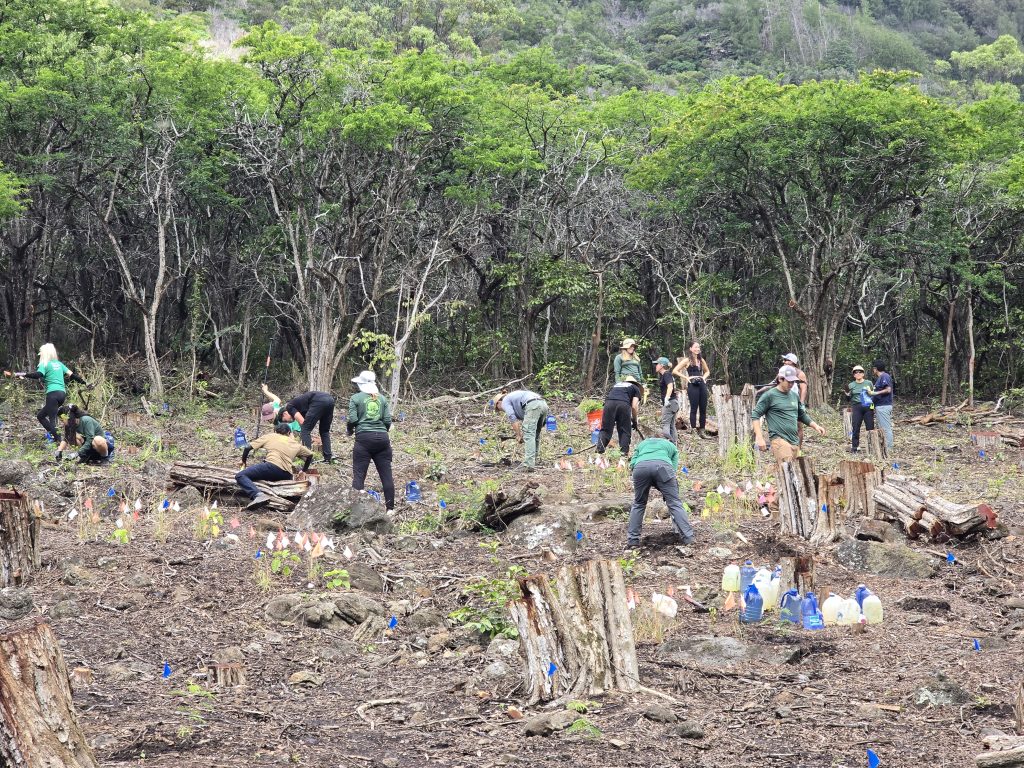
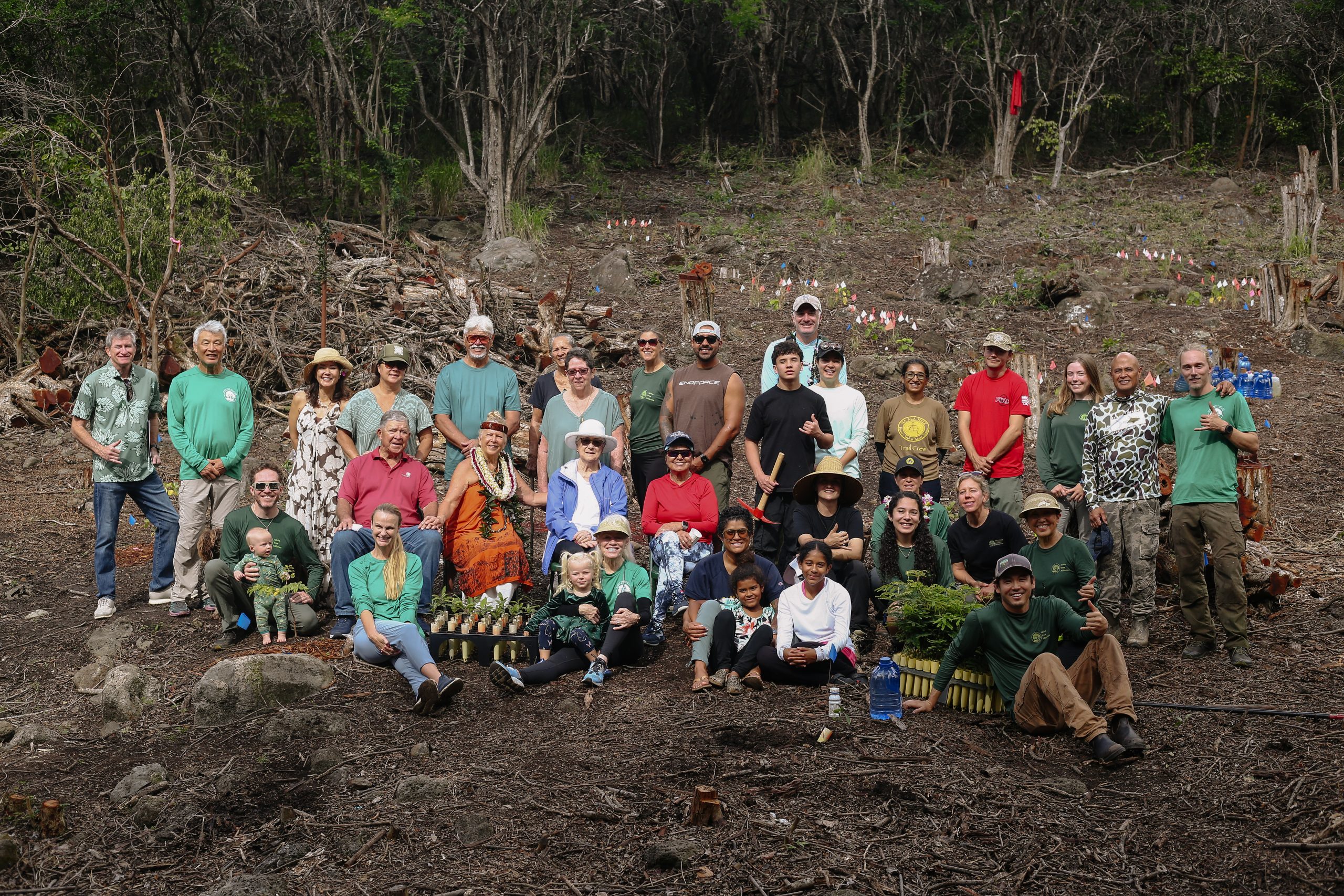
Saturday, February 28, 2026, marked a ceremonious and celebratory day as ATA’s partners and community members gathered for the blessing of the Kuliʻouʻou Hawaiian Hardwoods Community Forest site. Expert conservationists, cultural practitioners, and master artisans shared ʻike (knowledge) and helped plant two new species, Koa and Lama, bringing the site’s total to four native species. The HHCF site is also home to the endangered Naʻu (Hawaiian Gardenia), and ʻUhiʻuhi, a hardwood so dense it sinks in water.
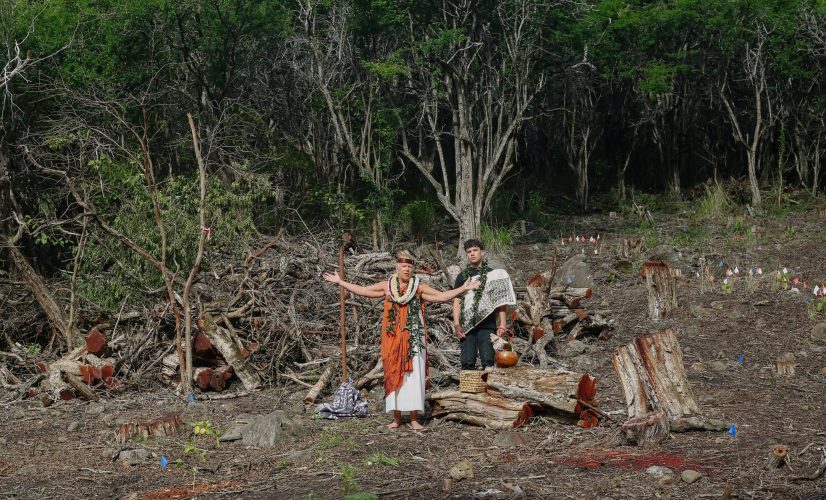
Cultural protocol and ceremony were led by ʻAnakē Keolani Noa, and Pheonix, a high school student from Kamehameha Schools. Wai was used to bless the boundaries of the project, oli (chant) was offered by all participants, and more than 70 native plants were added to the 0.46-acre cleared site.
People who all love trees were sprinkled across the newly cleared landscape. The forest was alive with energy, from families with young children to environmental stewards from other projects, all united by their love of trees and the ‘āina. Warm conversations, “ooʻs” and “ahʻs,” and soft laughter filled the space. Everyone was bustling with ideas and hope for what this space will become. Each person’s presence, from political leaders to community volunteers, plays a vital role in the success of this living cultural and ecological legacy.
Hawaiian Hardwoods Project Background
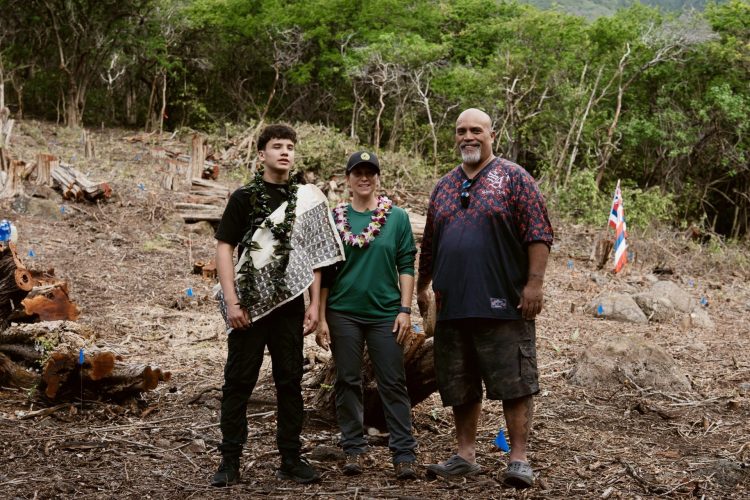
The vision for the Hawaiian Hardwoods Community Forest at Kuliʻouʻou began with two champions: Susan Ching, DOFAW Oʻahu Botanist, and Nalu Andrade, traditional wood carver and Kaulunani Urban and Community Forestry Program’s first Artist in Residence. Their goal was “to ensure a sustainable supply of culturally significant hardwoods while perpetuating the practices that depend upon them,” a vision that is now taking root at Kuliʻouʻou.
The project brings together conservation priorities, cultural values, and community participation across generations. Nalu Andrade reflects on the momentous occasion of watching kids plant alongside the elders from Kuliʻouʻou, “to witness the connection of generations is what makes this place special. It’s more than just planting; it’s fostering a deeper relationship with the land and people.” He was also excited that people also traveled from near and far to participate. The blessing marked the beginning of an opportunity to foster intergenerational relationships and strengthen connections across the island.
A partnership between ATA, the Hawaiʻi State Division of Forestry and Wildlife (DOFAW), the National Fish and Wildlife Foundation (NFWF), Kaulunani, the US Forest Service and the Donald and Astrid Monson Education Fund made this project possible. These collaborations allow for a multi-faceted approach that addresses public and private partnership in conservation, climate resilience and cultural stewardship.
One of five hardwood project sites across Hawaiʻi, Kuliʻouʻou takes a biocultural approach: increasing access to harvesting native hardwoods while protecting and preserving them. ATA Field and Nursery Manager Eli Livezey explains that this project pushes the boundaries of traditional conservation, encouraging participants to view the forest through an agroforestry lens, where natural resources are both cared for, harvested and thoughtfully used, ensuring sustainability for generations to come.
The Evolution of Conservation
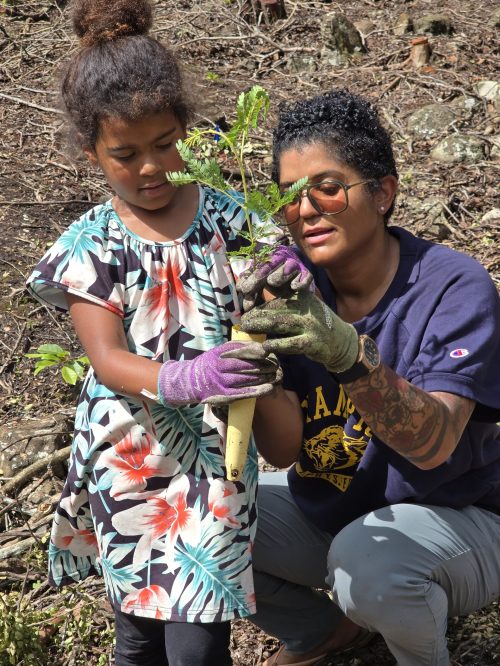
Historically, conservation has often been framed as protecting land by removing people from the landscape—think locked fences, no-take zones, and natural area reserves. While these approaches can safeguard fragile ecosystems and endangered species, they overlook a deeper truth: humans have long been an integral part of forest ecosystems. In Hawaiʻi and many Indigenous contexts, people and forests have coexisted in relationships rooted in care, responsibility, and reciprocity. Biocultural approaches build on this understanding, offering a model that may be better suited for restoration sites like our Hawaiian Hardwoods Community Forest. By integrating cultural practices with ecological restoration, and drawing from Hawaiian values like aloha ʻāina, we can foster mutually beneficial relationships between people and place. In doing so, biocultural approaches support conservation goals such as protecting native species, promoting biodiversity, increasing long-term native plant viability, improving watershed recharge, and enhancing resilience to environmental disturbances, all while strengthening the reciprocal bonds between humans and nature (Winter et al., 2020).
After developing a species list and considering the unique place-based needs of Kuliʻouʻou, plants were selected with several priorities in mind. DOFAW Community Forester Shimona Quazi explains her approach, “I start with a question: What is this going to look like in 80 years? And when people want to harvest, what is the likelihood we will have plenty of options? My guiding principles are 1) survivorship; 2) what’s going to resemble what we had before; and 3) what serves the purposes of community? That’s the biocultural component.”
Cultural preservation is at the heart of this site. Traditional ecological knowledge (TEK), is built through generations of observation, practice, and ʻike kupuna (ancestral knowledge). It offers invaluable guidance for how we care for and interact with this landscape. TEK deserves recognition in the conservation world and ATA is committed to holding space for cultural practices, indigenous ways of knowing, and ʻike sharing. In doing so, we not only restore ecosystems, but also strengthen the knowledge systems and relationships that have sustained them for generations. Nalu Andrade is already making plans to teach workshops in the Hawaiian Hardwoods Community Forest.
ATA’s work demonstrates that conservation efforts do not need to be devoid of humans. In fact, our efforts rely on the support of our volunteer community. Shimona chimed in on the importance of community centered work and explained that Hawaiʻi is not only well placed but also a strong global leader in implementing community-based management strategies. The Hawaiian Hardwoods Community Forest project is specifically designed to provide a gathering space and natural resources for the community. We hope that many organizations, schools, and halau adopt this site and in turn regain a sense of belonging, pilina, and self determination. This project asks the question: How will the community be involved from now until the next 50 years when we harvest? Shimona’s answer rang with clarity, “We can contribute to something that is bigger than ourselves.”
Mahalo nui loa to the many hands and minds that helped bring new life to our Hawaiian Hardwoods Community Forest at Kuliʻouʻou. If you are interested in volunteering or learning more about this space please reach out to us at info@alohatreealliance.org.
Recommended Reading:
Biocultural Restoration in Hawai‘i Also Achieves Conservation Goals
– Kawika Winter, Tamara Ticktin, and Shimona Quazi